
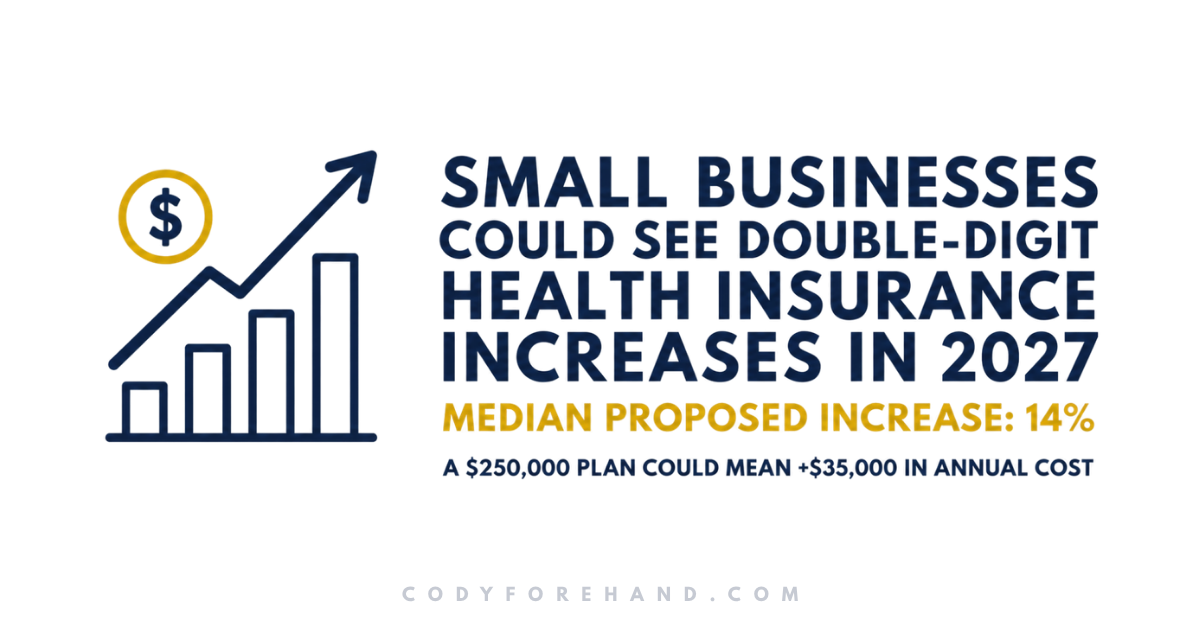
A 14% increase doesn’t just affect your benefits budget.
It affects what you can spend everywhere else in your business.
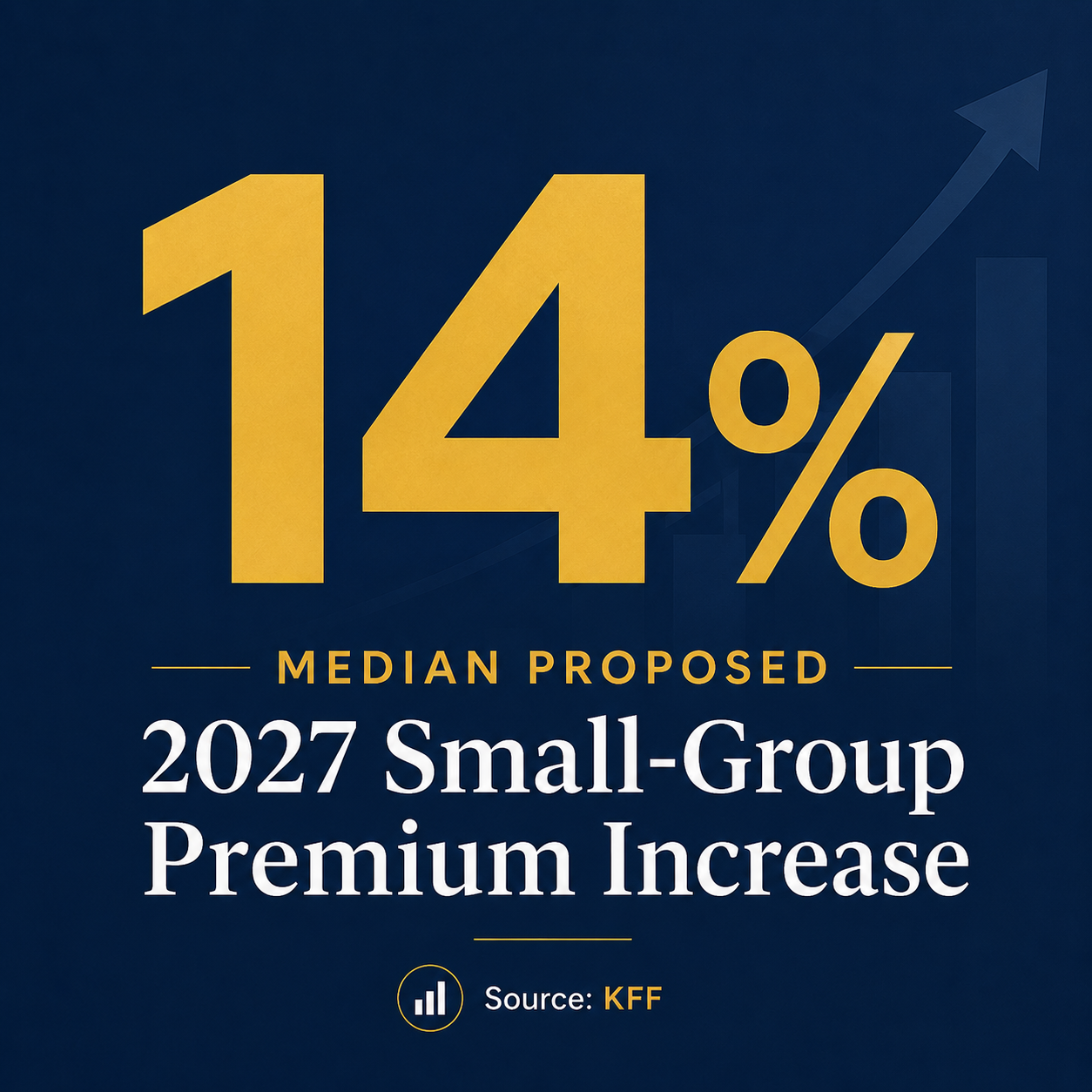 KFF recently analyzed preliminary 2027 health insurance rate filings from nearly 300 insurers offering small-group coverage across the country.
The median proposed premium increase?
14%.
To put that into dollars, consider a small business currently spending $250,000 a year on health insurance.
A 14% increase represents another $35,000 in annual expense.
No additional employee.
No better benefits.
No new equipment.
No additional revenue.
Just another $35,000 added to the cost of maintaining the existing health plan.
And while these are preliminary filings—not a prediction that every employer will receive a 14% renewal—they’re another indication that employers should be preparing for a difficult health insurance market in 2027.
What’s driving the increases?
According to KFF’s analysis, insurers are pointing to several familiar pressures:
- Higher hospital and physician costs
- Rising prescription drug spending
- Increased healthcare utilization
- Continued pressure on the traditional fully insured small-group market
There’s another trend worth paying attention to.
The number of people covered through the fully insured small-group market declined approximately 41% between 2013 and 2024, falling from roughly 17 million to 10 million.
As employers look for alternatives—including level funding and self-funding—the traditional small-group insurance pool continues to change.
For employers who remain in that market, simply waiting for the renewal and shopping carriers may become an increasingly difficult strategy.
Don’t start with: “How do we absorb the increase?”
That’s often the first reaction when an employer receives a large renewal.
Can we increase employee contributions?
Raise the deductible?
Change carriers?
Reduce benefits?
Those may eventually be part of the conversation, but I think employers should start somewhere else.
Why are we paying this much in the first place?
Before deciding how to absorb another increase, understand the program you’re already paying for.
That means asking:
Where are our healthcare dollars actually going?
What’s driving our costs?
Is our current funding arrangement still appropriate?
Are we paying premium dollars to transfer risk that we’d be better off retaining?
Are there opportunities to improve benefits without simply spending more?
Are we taking advantage of the tax efficiencies available within our benefits program?
Those questions move the conversation away from simply buying insurance and toward managing one of the company’s largest expenses.
Your renewal shouldn’t be the beginning of the conversation
One of the biggest mistakes I see employers make is waiting until the renewal arrives to start evaluating the program.
If your renewal comes back at +10%, +14%, or +20%, the natural reaction is to start looking for alternatives.
But by then, the clock is working against you.
Meaningful analysis takes time. So does evaluating funding strategies, reviewing claims, negotiating with carriers, considering plan-design changes, and communicating those changes to employees.
The earlier you start, the more options you generally have.
Ideally, the work begins months before the carrier tells you what next year’s premium will be.
Look beyond the renewal
A health plan shouldn’t be evaluated solely on whether this year’s increase was 8% instead of 14%.
The bigger question is whether the program is working efficiently for both sides of the equation:
The employer: What are we spending, what are we getting for those dollars, and how do we manage the long-term cost curve?
The employee: What comes out of their paycheck, what happens financially when they actually need care, and how much value are they receiving from the benefit?
A cheaper premium isn’t necessarily a better health plan.
And a richer health plan isn’t necessarily a more expensive one.
The opportunity is often in how the dollars are structured.
Start before the renewal arrives
If you’re a small or midsized employer with a 2027 renewal approaching, don’t wait for the renewal packet to decide whether you have a problem.
Start by understanding the program you have today.
Where is the money going?
What’s working?
What’s not?
And what could you change while you still have time to do something about it?
That’s the purpose of a Benefits Efficiency Review: to understand the economics of the current program before deciding what the next one should look like.
Because when healthcare costs are rising this quickly, simply renewing the same strategy and hoping for a better result next year isn’t much of a strategy.
Don’t wait for your renewal to find out you have a problem.
A Benefits Efficiency Review helps us understand where your healthcare dollars are going, what’s driving costs, what’s working and what opportunities may exist before the next renewal.